Table of Contents
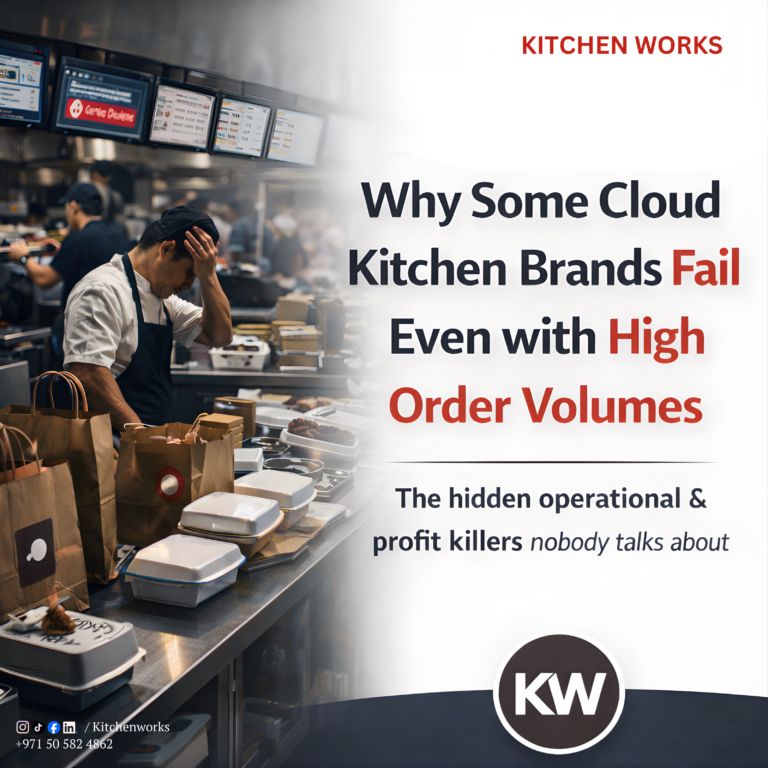
At first glance, high order volumes look like success. Daily orders are coming in. Delivery apps show strong traction. Revenue dashboards look healthy. Yet, behind the scenes, many cloud kitchen brands are quietly bleeding cash. In this article, we’ll break down the most common cloud kitchen failure reasons, explain how high order volume can actually hide deeper problems, and share actionable insights to help operators build sustainable, profitable brands.
Cloud kitchens are often portrayed as the ultimate low-risk, high-reward food business model. No dine-in space, lower upfront costs, and access to thousands of online customers—on paper, it sounds foolproof. Yet, many brands shut down even after achieving impressive daily order volumes.
This raises a critical question: why do cloud kitchens fail even when demand looks strong? The answer lies in a combination of operational blind spots, weak fundamentals, and misunderstood economics.
Whether you’re planning to launch a virtual kitchen or struggling to scale one, this article will help you avoid the mistakes that silently destroy promising food businesses.
Understanding cloud kitchen failure reasons is critical because orders do not equal profits. In fact, some of the fastest-growing cloud kitchens shut down because they grow too quickly without fixing fundamental issues.
This article breaks down exactly why cloud kitchen brands fail even with high demand, what most founders overlook, and how to build a resilient, profitable operation instead.
Understanding Cloud Kitchen Failure Reasons Beyond Order Volume
High order volume creates a dangerous illusion of success.
Many founders assume:
- More orders = more profit
- Growth will fix inefficiencies
- Scale will automatically improve margins
In reality, cloud kitchen failure reasons are rooted in weak fundamentals, not lack of demand.
Let’s break them down.
Cloud Kitchen Failure Related to Poor Unit Economics
Revenue is high, but margins are broken
One of the biggest cloud kitchen failure reasons is negative unit economics.
You may be selling a lot—but losing money on every order.
Common unit economics mistakes
- Underpricing menu items
- Ignoring platform commission impact
- High packaging costs
- Rising ingredient prices not reflected in pricing
If contribution margin per order is negative, higher volume only accelerates losses.
More orders with bad margins = faster failure
Delivery Platform Dependency: A Silent Cloud Kitchen Failure Reason
Many cloud kitchens are built entirely on third-party platforms.
This creates massive risk.
Problems with over-dependence
- 20–35% commission per order
- Algorithm changes kill visibility overnight
- No access to customer data
- Price wars encouraged by platforms
Cloud kitchen failure reasons often include lack of brand ownership.
When platforms control your customers, you control nothing.
Operational Inefficiencies That Cause Cloud Kitchen Failure
High volume exposes weak systems.
Signs of operational breakdown
- Order delays during peak hours
- Inconsistent food quality
- High cancellation rates
- Staff burnout
Root causes
- Poor kitchen layout
- No SOPs or recipe standardization
- Inadequate staff training
- Manual order handling
Operations that don’t scale smoothly are a top contributor to cloud kitchen failure reasons.
Cloud Kitchen Failure Reasons Linked to Poor Cost Control
Many cloud kitchens track revenue daily—but ignore costs weekly.
That’s a mistake.
Hidden cost leaks
- Food wastage
- Overstaffing during slow hours
- Emergency equipment repairs
- Utility inefficiencies
Without real-time cost tracking, profits disappear silently.
Cash flow issues, not lack of sales, shut down most kitchens.
Menu Complexity: An Overlooked Cloud Kitchen Failure Reason
More items don’t mean more sales.
They often mean:
- Higher inventory costs
- Longer prep times
- Increased errors
- Lower consistency
Why complex menus fail
- Too many ingredients
- Low-selling items eating margins
- Inconsistent execution
Successful brands simplify. Failing ones keep adding items hoping volume will compensate.
Menu bloat is a major cloud kitchen failure reason.
Staffing Issues That Lead to Cloud Kitchen Failure
People problems scale faster than systems.
Common staffing-related failure points
- High attrition
- Poor hiring standards
- Lack of accountability
- No performance tracking
When staff turnover is high, training costs rise and quality drops—hurting reviews and repeat orders.
Marketing Without Retention: A Costly Cloud Kitchen Failure Reason
Many brands spend heavily on acquiring customers.
Very few focus on keeping them.
What goes wrong
- No loyalty programs
- No CRM or remarketing
- No brand recall outside apps
You keep paying to acquire the same customers again and again.
High CAC with low repeat rates is one of the most dangerous cloud kitchen failure reasons. The Marketing is the crucial part for every business, We have to be careful while doing the digital marketing for every business. Consult with the professional digital Marketing Specialists before heavy spending.
Expansion Without Systems: The Fastest Way to Fail
Scaling too early is fatal.
Expansion mistakes
- Opening multiple locations without SOPs
- Inconsistent taste across kitchens
- No centralized procurement
- Poor quality audits
Growth magnifies flaws.
Brands that don’t fix systems before expansion often collapse under their own weight.
Real-World Example: High Orders, Low Survival
A fast-growing cloud kitchen brand hit 1,000+ daily orders across platforms.
But:
- Platform commissions were 28%
- Food cost averaged 38%
- Labor and rent took another 30%
Despite massive volume, the brand was losing money every month.
This is a classic example of cloud kitchen failure reasons driven by poor fundamentals—not demand
Core Cloud Kitchen Failure Reasons
- Broken unit economics
- Platform over-dependence
- Poor cost control
- Inefficient operations
- Menu complexity
- Weak infrastructure
- No customer retention strategy
- Scaling without systems
How to Avoid Cloud Kitchen Failure Even at High Volume
Build for profit, not vanity metrics
Focus on:
- Contribution margins per order
- Repeat customer rates
- Cost per order
- Operational efficiency
Key corrective actions
- Engineer menus for margin
- Diversify sales channels
- Standardize operations
- Invest in infrastructure early
- Track costs daily, not monthly
Conclusion: Understanding Cloud Kitchen Failure Reasons Saves Your Brand
Cloud kitchen brands don’t fail because people stop ordering.
They fail because systems break before profits appear.
By understanding the real cloud kitchen failure reasons—unit economics, operations, infrastructure, and retention—you can build a brand that survives high volume and thrives because of it.
Success in cloud kitchens isn’t about chasing orders.
It’s about designing a business that stays profitable no matter how fast it grows.
Cloud Kitchen Failure Reasons
What are the most common cloud kitchen failure reasons?
Poor unit economics, high platform commissions, weak operations, and lack of cost control.
Can a cloud kitchen fail even with high sales?
Yes. High order volumes often hide losses caused by poor margins and inefficiencies.
Is platform dependency risky for cloud kitchens?
Yes. Over-reliance on delivery apps limits profitability and customer ownership.
How important is infrastructure in cloud kitchen success?
Critical. Poor infrastructure leads to downtime, inefficiency, and quality issues.
What is the biggest mistake cloud kitchen founders make?
Scaling too fast without fixing unit economics and operational systems.