Table of Contents
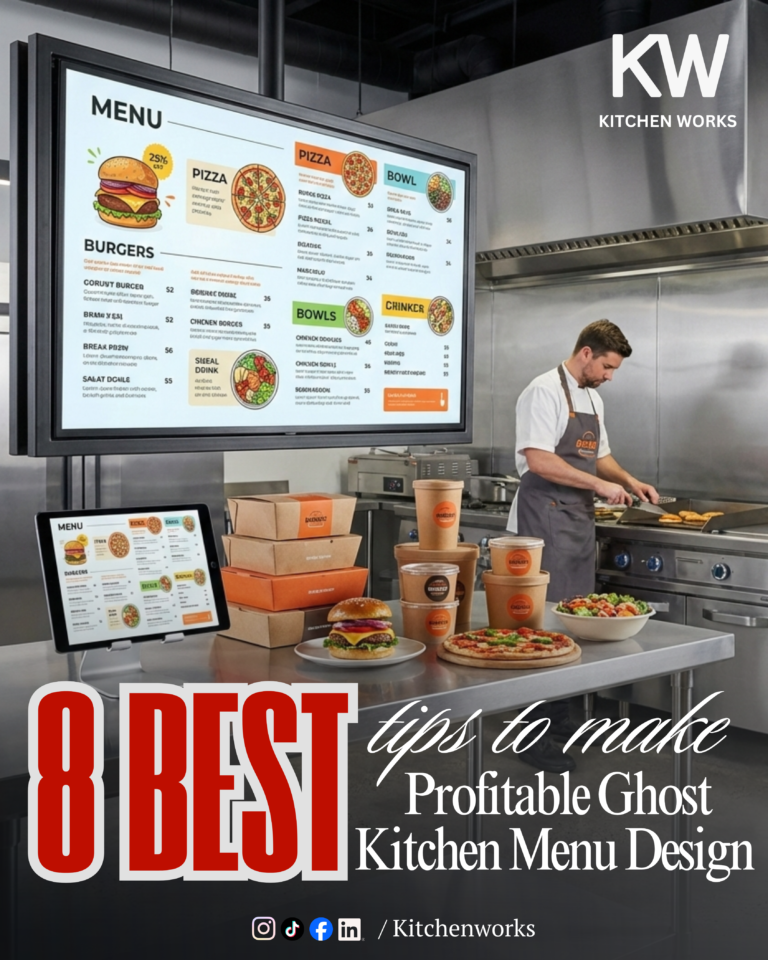
Your menu is not just a list of dishes. In a delivery-only business, Ghost Kitchen Menu Design is your biggest profit lever.
You can have great branding, strong order volume, and solid marketing—but if your menu is poorly designed, profits will leak on every order. Successful ghost kitchens don’t win by selling more items. They win by selling the right items, at the right margins, with the right operational simplicity.
In this article , we’ll break down 8 proven tips for Ghost Kitchen Menu Design that directly impact profitability, efficiency, and scalability.
Why Ghost Kitchen Menu Design Is the Foundation of Profitability
Unlike traditional restaurants, ghost kitchens operate under unique constraints:
- No dine-in experience
- High delivery commissions
- Packaging costs
- Limited prep space
- Speed expectations
That’s why Ghost Kitchen Menu Design must be delivery-first, margin-focused, and operations-friendly.
A well-designed menu can:
- Increase contribution margin per order
- Reduce food waste
- Improve preparation speed
- Boost repeat orders
Tip 1: Design Your Ghost Kitchen Menu for Contribution Margin, Not Popularity
One of the biggest mistakes founders make is building menus around popular dishes instead of profitable dishes.
What contribution margin really means
Contribution margin =
Selling price – (food cost + packaging + platform commission + variable labor)
In Ghost Kitchen Menu Design, this number matters more than revenue.
How to apply this tip
- Calculate margin per dish, not just food cost
- Remove items with consistently low margins
- Highlight high-margin items visually on menus
A dish that sells less but earns more is better than a bestseller that loses money.
Tip 2: Limit Menu Size to Improve Ghost Kitchen Menu Design Efficiency
More items = more problems.
Why smaller menus perform better
- Faster prep times
- Lower inventory complexity
- Reduced wastage
- Better consistency
The most profitable ghost kitchens operate with 10–20 core SKUs, not 50+ items.
Best practice
- Focus on 1–2 core cuisines
- Eliminate low-performing items monthly
- Avoid seasonal experimentation without data
Minimalism is a superpower in Ghost Kitchen Menu Design.
Tip 3: Engineer Menu Items Using Shared Ingredients
Ingredient overlap is one of the smartest Ghost Kitchen Menu Design strategies.
Why shared ingredients boost profitability
- Bulk purchasing reduces cost
- Lower storage requirements
- Easier inventory management
- Reduced spoilage
Example
Instead of:
- 5 different sauces with 5 different bases
Use:
- 2 base sauces with flavor variations
Smart ingredient engineering keeps your kitchen lean and profitable.
Tip 4: Design Your Ghost Kitchen Menu for Delivery Survivability
If it doesn’t travel well, it doesn’t belong on a ghost kitchen menu.
Delivery-first design principles
- Avoid items that turn soggy quickly
- Choose foods that retain heat and texture
- Test packaging with real delivery times
Common mistakes
- Fries without vented packaging
- Saucy dishes without separation
- Delicate plating-style items
Ghost Kitchen Menu Design must prioritize customer experience at the doorstep, not at the pass.
Tip 5: Price Strategically to Offset Platform Commissions
Delivery platforms take a significant cut.
Ignoring this is one of the fastest ways to lose money.
Smart pricing strategies
- Slightly higher prices on aggregator platforms
- Combo meals with higher margins
- Add-ons that increase average order value
Psychological pricing works
- 19AED feels better than 22AED
- Bundles feel like value, even with higher margins
Pricing is not guesswork—it’s a core Ghost Kitchen Menu Design skill.
Tip 6: Reduce Preparation Time Through Smart Menu Design
Time is money in a ghost kitchen.
How prep time impacts profitability
- Slower prep = fewer orders per hour
- More errors under pressure
- Higher labor costs
How to optimize
- Use semi-prepped components
- Batch-cook base items
- Avoid last-minute complex assembly
Menus designed for speed outperform complex ones every time.
Tip 7: Use Menu Psychology to Guide Customer Choices
Most customers don’t read menus—they scan them.
Menu design psychology tactics
- Place high-margin items at the top
- Use descriptive names strategically
- Limit choice overload
Visual hierarchy matters
- Bold bestsellers (that are profitable)
- Avoid highlighting low-margin items
- Use “Chef’s Special” or “Most Ordered” wisely
Good Ghost Kitchen Menu Design nudges customers toward profit-friendly decisions.
Tip 8: Continuously Optimize Your Ghost Kitchen Menu Using Data
A menu is never finished.
The best ghost kitchens treat menu design as an ongoing process.
Metrics to track
- Contribution margin per item
- Order frequency per SKU
- Preparation time
- Customer ratings by item
Monthly optimization routine
- Remove bottom 10–20% performers
- Test price adjustments
- Introduce limited-time, high-margin items
Data-driven Ghost Kitchen Menu Design wins long term.
Common Ghost Kitchen Menu Design Mistakes to Avoid
Even experienced operators fall into these traps:
- Designing menus like dine-in restaurants
- Ignoring packaging costs
- Chasing trends instead of margins
- Offering too many customizations
Every added complexity eats into profit.
Real-World Example: Menu Design Turning Loss into Profit
A burger-focused ghost kitchen redesigned its menu:
Before:
- 42 items
- 18 ingredients
- Average margin: 12%
After optimization:
- 16 items
- 9 core ingredients
- Average margin: 28%
Same kitchen. Same demand. Better Ghost Kitchen Menu Design.
Bullet-Point Summary: Profitable Ghost Kitchen Menu Design
- Focus on contribution margins
- Keep menus small and focused
- Share ingredients across dishes
- Design for delivery, not plating
- Price for platform economics
- Reduce prep time
- Use menu psychology
- Optimize continuously using data
Conclusion:
Ghost Kitchen Menu Design is not creative decoration—it’s business strategy.
The brands that win don’t have the biggest menus.
They have the smartest menus—engineered for margins, speed, and scale.
If you want sustainable profits, start with your menu.
Because in ghost kitchens, the menu decides everything.
FAQs:
What is Ghost Kitchen Menu Design?
Ghost Kitchen Menu Design is the process of creating a delivery-first, margin-focused menu optimized for profitability, speed, and scalability.
How many items should a ghost kitchen menu have?
Ideally 10–20 core items, depending on cuisine and kitchen capacity.
Why is menu design critical for ghost kitchen profitability?
Because margins, prep time, and operational efficiency are all driven by menu structure.
Should ghost kitchen menus change often?
Yes. Regular data-driven optimization improves profitability over time.
Can one menu support multiple brands?
Yes, if ingredient overlap and prep processes are designed correctly.