Table of Contents
Introduction: Cloud KITCHEN HEALTH REGULATIONS IN UAE
The rise of cloud kitchens in the UAE has transformed the food service landscape, but with increasing adoption comes a clear responsibility—strict adherence to cloud kitchen health regulations in UAE. Operators who understand and comply with these rules protect customers, minimize operational disruptions, and create a sustainable business model that meets national food safety expectations.
In the UAE, the authorities view food safety as a critical public welfare concern. Cloud kitchens operate without traditional dine-in experiences, which means their operational integrity hinges on consistent hygiene, safe food handling, and reliable infrastructure design. Whether you are an aspiring entrepreneur or an established operator, aligning your operations with UAE health and safety standards is not optional—it is a licensing requirement and the backbone of long-term success.
Regulatory Framework Governing Cloud Kitchens in the UAE
Cloud kitchens fall under the same food safety governance as traditional restaurants, but the regulatory approach differs slightly due to the unique nature of virtual operations. Understanding the legal landscape is the first step toward meeting cloud kitchen health regulations in UAE.
Municipal & Federal Authorities
Several bodies oversee food safety and hygiene:
- Dubai Municipality (DM) – regulates licensing, Food Code enforcement, inspections, and facility approval.
- Abu Dhabi Agriculture & Food Safety Authority (ADAFSA) – oversees food control in Abu Dhabi.
- Sharjah Municipality & Other Emirates – issue approvals and enforce safety guidelines across respective jurisdictions.
- Ministry of Climate Change and Environment (MOCCAE) – sets federal food safety policies.
Each emirate follows the UAE Food Code as the foundation for compliance, but local municipalities may issue additional guidelines. Cloud kitchens must secure the appropriate trade license, food license, and kitchen facility approvals before operations begin.
Key Regulatory Tools
- UAE Food Code (primary guide for hygiene, safety & facility design)
- Hazard Analysis & Critical Control Point (HACCP) standards
- Municipality-issued hygiene and inspection protocols
- Food Safety Management System (FSMS) requirements
Compliance with these frameworks ensures a legally sound foundation for kitchen operations.
Core Health & Hygiene Standards for Food Preparation
Food preparation standards are at the heart of UAE cloud kitchen health regulations. Since cloud kitchens rely heavily on centralized production, the level of hygiene demanded is exceptionally high.
Food Hygiene Controls
Food must be procured, prepared, cooked, cooled, stored, and delivered to align with microbial safety limits. The entire process must follow clearly defined rules that minimize contamination risk:
- Raw and cooked foods must be handled separately to avoid cross-contamination.
- Food preparation areas must maintain strict sanitation and be disinfected at defined intervals.
- Chilled and hot foods must be maintained within safe temperature thresholds to prevent harmful bacterial growth.
- High-risk food categories (meat, poultry, seafood, dairy) require specially designated areas and equipment.
Allergen & Contamination Prevention
The UAE Food Code emphasizes clear allergen management. Cloud kitchens must:
- Label ingredients correctly
- Prevent allergen cross-contact
- Maintain allergen-specific prep tools
The kitchen’s workflow should be calibrated to ensure safety at every stage—from sourcing to delivery dispatch.
Facility Design, Layout & Structural Requirements
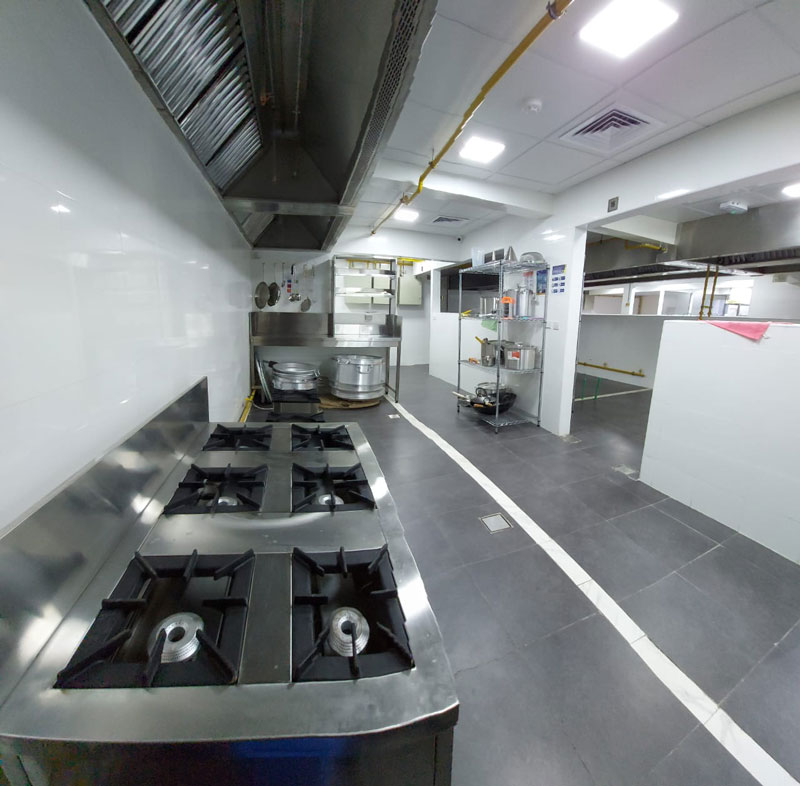
The UAE mandates strict structural guidelines to support the hygienic production of food. These standards ensure that kitchen spaces remain safe, easy to sanitize, and optimized for safe operations. Meeting these physical requirements is central to cloud kitchen health regulations in UAE.
Facility Layout
- Adequate space must be allocated for cooking, washing, chilling, storage, and delivery dispatch.
- Workflows must prevent the crossing of raw and cooked food pathways.
- Floors must be non-absorbent, slip-resistant, and free of cracks.
- Walls and ceilings must be smooth, durable, and washable.
Ventilation and Lighting
- Mechanical ventilation must prevent smoke and grease buildup.
- Airflow direction must not contaminate food preparation areas.
- Lighting should be sufficient and protected with shatterproof covers.
Drainage and Water Supply
- Clean potable water must be accessible at all times.
- Drainage systems must prevent backflow and be maintained regularly.
These structural rules form the backbone of operational safety, especially in high-volume cloud kitchen environments.
Equipment, Storage & Temperature Control Compliance
Maintaining proper equipment and temperature monitoring is another crucial aspect of cloud kitchen health regulations in UAE.
Equipment Requirements
- Food-contact surfaces must be made of non-corrosive, washable materials.
- Cutting boards, knives, and prep tools must be dedicated for specific food categories.
- Kitchen equipment must undergo routine maintenance to ensure safe performance.
Storage Compliance
- Dry storage must remain free from moisture and pests.
- Refrigerators and freezers must have calibrated digital thermometers.
- Raw materials must be stored separately from ready-to-eat items.
Temperature Control Standards
- Hot food must be maintained above 60°C.
- Cold food must be kept below 5°C.
- Temperature logs must be updated regularly as part of FSMS.
Failure to maintain proper temperature control is one of the most common violations observed during inspections. Temperature control is central to Cloud kitchen health regulations in UAE.
Staff Hygiene, Training & Medical Fitness Rules
Personnel who handle food are required to maintain the highest levels of personal hygiene. The UAE places great emphasis on employee readiness within cloud kitchen health regulations. Staff training must follow Cloud kitchen health regulations in UAE.
Mandatory Staff Training
Food handlers must undergo municipality-approved training programs such as:
- Person-in-Charge (PIC) certification
- Food safety training provided by approved institutes
Training ensures staff understand contamination risks, hygiene procedures, temperature control, and safe food handling. Good hygiene habits align with Cloud kitchen health regulations in UAE.
Medical Fitness Requirements
- Food handlers must hold valid medical fitness certificates.
- Regular medical checkups must be documented and updated.
Personal Hygiene Rules
- Clean uniforms, hairnets, gloves, and aprons are mandatory.
- Jewelry is prohibited while working.
- Handwashing must follow defined procedures and be done frequently.
Employee compliance is studied closely during inspections, making it essential for cloud kitchens to continuously reinforce hygiene behavior.
Cleaning, Waste Management & Pest Control Protocols
Clean workplaces support Cloud kitchen health regulations in UAE. A cloud kitchen’s hygiene reputation depends on consistent cleaning practices supported by detailed documentation.
Cleaning Protocols
- Cleaning schedules must outline daily, weekly, and monthly tasks.
- Approved sanitizing chemicals must be used in correct dilution.
- Utensils and equipment must be disinfected after every task cycle.
Waste Management Rules
- Waste must be segregated and stored in sealed containers.
- Disposal must follow municipality guidelines.
- Waste areas must be cleaned and disinfected frequently.
Pest Control Systems
- Pest control must be carried out by licensed service providers.
- Records of treatments and inspections must be maintained.
- Access points must be sealed to prevent pest entry.
Cleanliness is non-negotiable; inspectors treat lapses in these areas as high-risk violations of cloud kitchen health regulations.
Food Handling, Delivery & Packaging Safety Rules
Cloud kitchens must extend food safety to the delivery stage, ensuring that food remains safe from kitchen to customer.
Safe Food Handling
- Ready-to-eat items must be handled separately from raw food.
- Tools and surfaces must be sanitized before each use.
- Portioning must follow specific handling protocols.
Packaging Requirements
- Packaging must be food-grade, leak-proof, and able to maintain temperature.
- Branding must not interfere with hygiene standards.
- Tamper-evident packaging is highly recommended.
Delivery Protocols
- Delivery riders must maintain insulated boxes.
- Hot and cold items must be separated.
- Delivery timelines should preserve food quality and safety.
The UAE considers the entire supply chain part of the food safety ecosystem, so delivery hygiene is an extension of the kitchen’s responsibilities.
Documentation, Record-Keeping & Mandatory Inspections
Licensing depends on meeting Cloud kitchen health regulations in UAE. Documentation is one of the pillars of cloud kitchen health regulations in UAE. Authorities require operators to record and maintain compliance evidence.
Essential Records
- Temperature logs
- Cleaning schedules
- Pest control certificates
- Equipment maintenance logs
- Staff training certificates
- Supplier records
Periodic Inspections
Municipal inspectors will assess:
- Food hygiene compliance
- Structural condition
- Storage systems
- Staff behavior
- Documentation
A strong FSMS ensures that all records are updated and available at all times.
How Kitchen Works Supports Cloud Kitchen Compliance in the UAE
Kitchen Works helps cloud kitchen owners navigate the regulatory landscape by providing fully compliant kitchen setups, equipment, and operational support. Our facilities are designed in alignment with UAE Food Code standards, making it easier for businesses to meet cloud kitchen health regulations in UAE without unnecessary delays or friction.
What Kitchen Works Provides
- Fully compliant, pre-approved kitchen spaces
- HACCP-aligned layouts and equipment
- Support with licensing and municipality approvals
- Professional guidance on safety and hygiene documentation
- Ongoing facility maintenance to ensure continuous compliance
We enable entrepreneurs and brands to operate confidently, knowing their kitchen meets all legal and safety requirements right from day one.
Final Thoughts
Growth becomes easier when Cloud kitchen health regulations in UAE are followed. The UAE’s commitment to food safety demands that every cloud kitchen follows strict health and hygiene protocols. Understanding and implementing cloud kitchen health regulations in UAE protects public health, ensures operational continuity, and builds long-term trust with customers.
With the right infrastructure, trained staff, and systematic compliance approach, cloud kitchens can thrive in the UAE’s rapidly expanding digital food ecosystem. Each brand must comply with Cloud kitchen health regulations in UAE. Kitchen Works stands ready to support operators at every step—empowering them to launch, scale, and sustain their businesses with complete confidence.
Frequently Asked Questions
1. What are the main cloud kitchen health regulations in the UAE?
The UAE enforces a comprehensive set of cloud kitchen health regulations guided by the national Food Code, municipality inspection criteria, HACCP principles, and food handler training mandates. These regulations govern facility layout, ventilation, staff hygiene, food handling, storage, and delivery safety. Cloud kitchens must comply fully to maintain licensing approval and avoid penalties.
2. Do cloud kitchens in Dubai need separate food licenses?
Yes. Dubai Municipality requires every cloud kitchen to obtain a food license and facility layout approval. These steps ensure the space meets structural and hygiene standards set by cloud kitchen health regulations before operations begin. Without these approvals, kitchens cannot legally prepare or deliver food in the emirate.
3. Are there temperature monitoring requirements for cloud kitchens?
Absolutely. Temperature control is a core part of cloud kitchen health regulations. Hot foods must remain above 60°C, and cold foods below 5°C. Regular temperature logs must be documented and available for inspection. Digital thermometers and calibrated cooling equipment are mandatory.
4. What hygiene training is required for staff?
All employees must undergo municipality-approved food safety training. Person-in-Charge (PIC) certification is typically required for supervisors. This training ensures staff understand local cloud kitchen health regulations, contamination risks, hygiene standards, and food handling procedures.
5. How often are cloud kitchens inspected in the UAE?
Inspections occur routinely and can also be unannounced. Inspectors check facility cleanliness, food storage, staff hygiene, waste disposal, and documentation. Any violation of cloud kitchen health regulations may result in warnings, fines, temporary closure, or suspension of the food license.