Table of Contents
In 2026, the debate around cloud kitchen vs traditional restaurant in Dubai is more relevant than ever. Investors, food entrepreneurs, and international brands entering the UAE market are carefully evaluating whether a cloud kitchen or a traditional restaurant offers better profitability, scalability, and long-term sustainability.
The choice between a cloud kitchen vs traditional restaurant in Dubai affects capital investment, operational costs, expansion potential, and return on investment. With Dubai’s food delivery ecosystem rapidly expanding, understanding the financial and strategic differences between these two models is critical.
In this detailed guide, we compare cloud kitchen vs traditional restaurant in Dubai across investment cost, operational structure, ROI, scalability, risks, and growth opportunities.
Understanding the Difference Between Cloud Kitchen vs Traditional Restaurant in Dubai
What Is a Traditional Restaurant?
A traditional restaurant operates from a physical retail location and serves customers for dine-in, takeaway, and delivery. It requires:
- High-visibility retail space
- Interior design and furniture
- Front-of-house staff
- Service teams
- Kitchen operations
Revenue comes from in-store dining and delivery platforms.
What Is a Cloud Kitchen?
A cloud kitchen (also known as a ghost kitchen or delivery-only kitchen) operates exclusively for food delivery. There is no dine-in facility. Orders are received through food delivery apps or direct online channels.
The business focuses entirely on:
- Food production
- Packaging
- Delivery logistics
This model eliminates front-of-house operations and reduces rental and staffing costs significantly.
2. Initial Investment Comparison FOR Cloud Kitchen vs Traditional Restaurant in Dubai
Traditional Restaurant Investment in Dubai
Opening a dine-in restaurant in Dubai typically requires:
- Retail space deposit and rent
- Interior fit-out (design, decor, furniture)
- Kitchen equipment installation
- Licensing and approvals
- Recruitment of service and kitchen staff
- Marketing and branding costs
Estimated investment range (depending on size and location):
High capital requirement, often reaching several million AED for prime locations.
Cloud Kitchen Investment in Dubai
Launching a cloud kitchen usually involves:
- Renting a fully equipped commercial kitchen
- Basic branding and packaging setup
- Smaller operational team
- Digital marketing and aggregator registration
Estimated investment range:
Significantly lower compared to dine-in models, particularly when renting ready-to-operate kitchen spaces. Because there is no dine-in space, the upfront investment in cloud kitchen vs traditional restaurant in Dubai is significantly lower for the cloud kitchen model.
Capital Efficiency Verdict
From a capital exposure perspective, cloud kitchens offer a lower-risk entry into the F&B sector.
3. Operating Costs Breakdown
Traditional Restaurant Operating Costs
Major ongoing expenses include:
- Premium retail rent
- Large staff payroll (servers, hosts, cleaners)
- Utilities (higher consumption due to dining area)
- Maintenance and cleaning
- Marketing for foot traffic
- Delivery platform commissions
Operational overhead is high due to customer-facing infrastructure. When comparing cloud kitchen vs traditional restaurant in Dubai, cloud kitchens typically operate with leaner cost structures, improving net margins.
Cloud Kitchen Operating Costs
Key expenses include:
- Kitchen rent
- Smaller kitchen team
- Utilities
- Packaging
- Delivery platform commission
- Digital advertising
Since there is no dine-in space, expenses are streamlined.
Cost Efficiency Conclusion
Cloud kitchens reduce recurring overhead by eliminating non-production expenses, improving potential operating margins.
4. Revenue Potential & Profit Margins in Cloud Kitchen vs Traditional Restaurant in Dubai
Traditional Restaurant Revenue Streams
Revenue sources:
- Dine-in customers
- Delivery orders
- Catering
- Events
Advantages include higher average order value from dine-in experiences. However, seating capacity limits revenue scalability.
Cloud Kitchen Revenue Streams
Revenue sources:
- Online delivery platforms
- Direct website/app orders
- Multiple virtual brands from one kitchen
Cloud kitchens can operate several cuisine concepts from the same infrastructure, maximizing output without additional rent.
Profit Margin Comparison
While dine-in restaurants may generate higher per-ticket sales, cloud kitchens often achieve healthier net margins due to lower fixed costs.
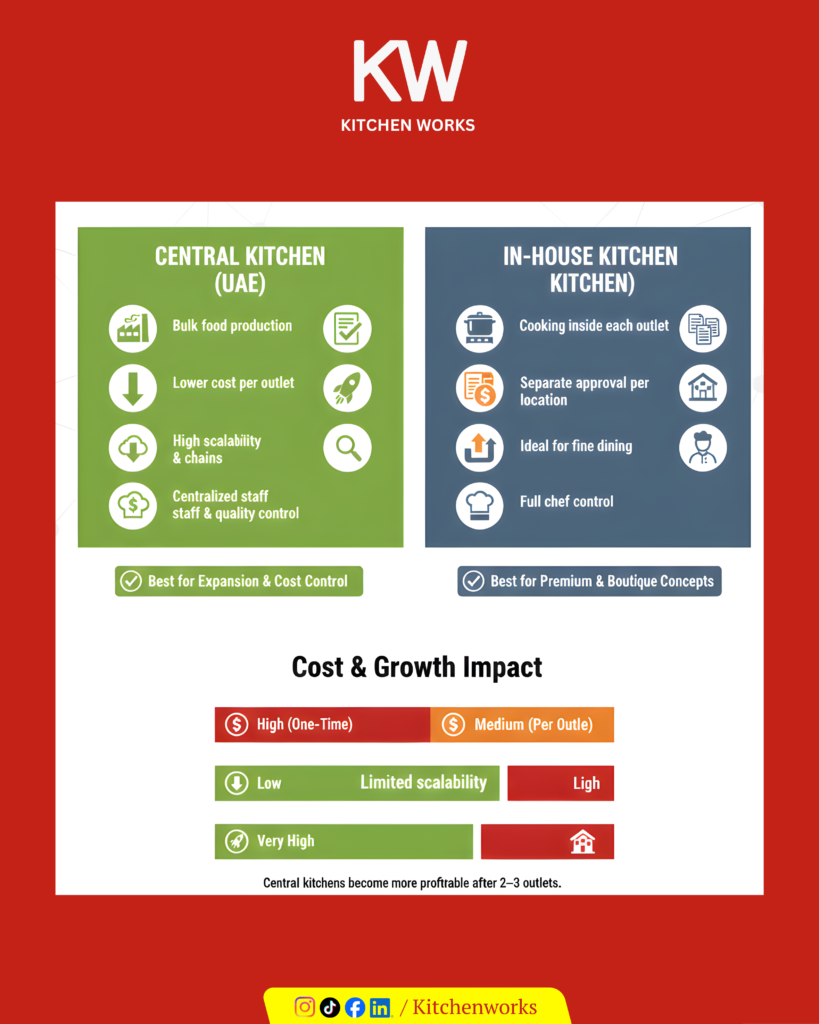
5. Scalability & Expansion – The Real Game Changer
Traditional Restaurant Scalability
Expanding requires:
- Securing new retail space
- Significant additional investment
- Large staff hiring
- New interior fit-outs
Expansion is slower and capital-intensive.
Cloud Kitchen Scalability
Cloud kitchens enable:
- Rapid multi-location expansion
- Testing new areas without long-term commitments
- Launching new virtual brands quickly
- Lower financial exposure per expansion
This makes the cloud kitchen model highly scalable.
6. Risk Analysis in Cloud Kitchen vs Traditional Restaurant
Risks in Traditional Restaurants
- High fixed rent
- Market fluctuations affecting footfall
- Economic downturn sensitivity
- Heavy upfront investment recovery timeline
Risks in Cloud Kitchens
- Dependency on delivery platforms
- Strong competition
- Need for digital marketing expertise
However, financial exposure per unit is lower.
7. ROI Timeline Comparison
Traditional restaurants often require 18–24 months to break even.
Cloud kitchens may reach break-even in 6–12 months depending on concept and management.
This difference strongly influences investor decisions in cloud kitchen vs traditional restaurant in Dubai profitability planning.
8. Location Strategy Differences
Traditional restaurants rely on:
- High foot traffic
- Mall presence
- Premium visibility
Cloud kitchens rely on:
- Delivery density
- Central connectivity
- Efficient logistics
Areas like Al Quoz provide cost-effective access to multiple residential zones within short delivery times.
9. Consumer Behavior in 2026
Modern consumers increasingly prioritize:
- Convenience
- Fast delivery
- Online ordering
- Digital payment
According to UAE food delivery market insights (reference: Statista UAE Food Delivery Market), online food ordering continues growing year after year.
However, experiential dining continues to support traditional restaurants in premium segments.
10. ROI Timeline Comparison
Traditional restaurants may take longer to break even due to higher capital recovery needs.
Cloud kitchens typically have:
- Lower break-even points
- Faster ROI timeline
- Lower sunk costs
For investors seeking quicker capital recovery, cloud kitchens often present stronger financial efficiency.
11. Which Model Is More Profitable in Dubai?
When it comes to Cloud Kitchen vs Traditional Restaurant in Dubai comparison The answer depends on investor goals:
Choose Traditional Restaurant If:
- You aim to build a luxury dining brand
- You rely heavily on experience-driven customers
- You have strong capital backing
Choose Cloud Kitchen If:
- You want scalable, capital-efficient growth
- You prioritize delivery demand
- You seek faster ROI
- You prefer lower financial risk
12. Hybrid Models: The Emerging Strategy
Some brands use a hybrid model:
- Launch as cloud kitchen
- Build brand awareness
- Expand into flagship dine-in locations
This phased approach reduces initial risk while allowing long-term brand growth.
Conclusion
Dubai’s F&B industry offers immense opportunity, but choosing the right business model is critical.
Cloud kitchens provide:
- Lower capital requirement
- Faster launch
- Reduced operating costs
- Strong scalability
Traditional restaurants provide:
- Brand experience
- Premium positioning
- In-store customer engagement
For many modern investors in 2026, cloud kitchens represent a more financially efficient and scalable entry into Dubai’s competitive food market.