Table of Contents
Introduction
In the highly competitive UAE food and beverage industry, restaurant success is no longer driven by food quality alone. Smart commercial kitchen design plays a critical role in determining operational efficiency, staff productivity, compliance, and ultimately restaurant profitability.
From Dubai and Abu Dhabi to Sharjah and Ajman, restaurant owners and investors are increasingly realizing that a well-planned commercial kitchen design in the UAE can significantly reduce costs, improve workflow, and increase return on investment (ROI).
In this blog, we explore how commercial kitchen design directly impacts restaurant profitability in the UAE, why it matters, and how professional kitchen planning can turn operational challenges into long-term business advantages.
Why Commercial Kitchen Design Is a Profit Driver (Not Just a Setup Cost)
Many restaurant owners see kitchen design as a one-time setup expense. In reality, it is a strategic investment that affects:
- Food preparation speed
- Labor efficiency
- Utility consumption
- Health & safety compliance
- Equipment lifespan
- Customer satisfaction
A poorly designed kitchen leads to wasted time, higher staff turnover, increased energy bills, and frequent maintenance issues—all of which eat into profits.
On the other hand, a professionally designed restaurant kitchen layout improves daily operations and supports business growth.
Understanding the UAE Restaurant Market & Its Challenges
The UAE has one of the most diverse and fast-growing foodservice sectors in the world. However, it also presents unique challenges:
Key UAE-Specific Factors:
- Strict food safety regulations (Dubai Municipality, Abu Dhabi Agriculture & Food Safety Authority)
- High rental costs per square foot
- Dependence on imported equipment and materials
- Multinational kitchen staff with varied experience levels
- High customer expectations for speed and consistency
A strategic commercial kitchen design UAE solution must address all these factors while maintaining cost efficiency.
How Commercial Kitchen Design Reduces Operational Costs
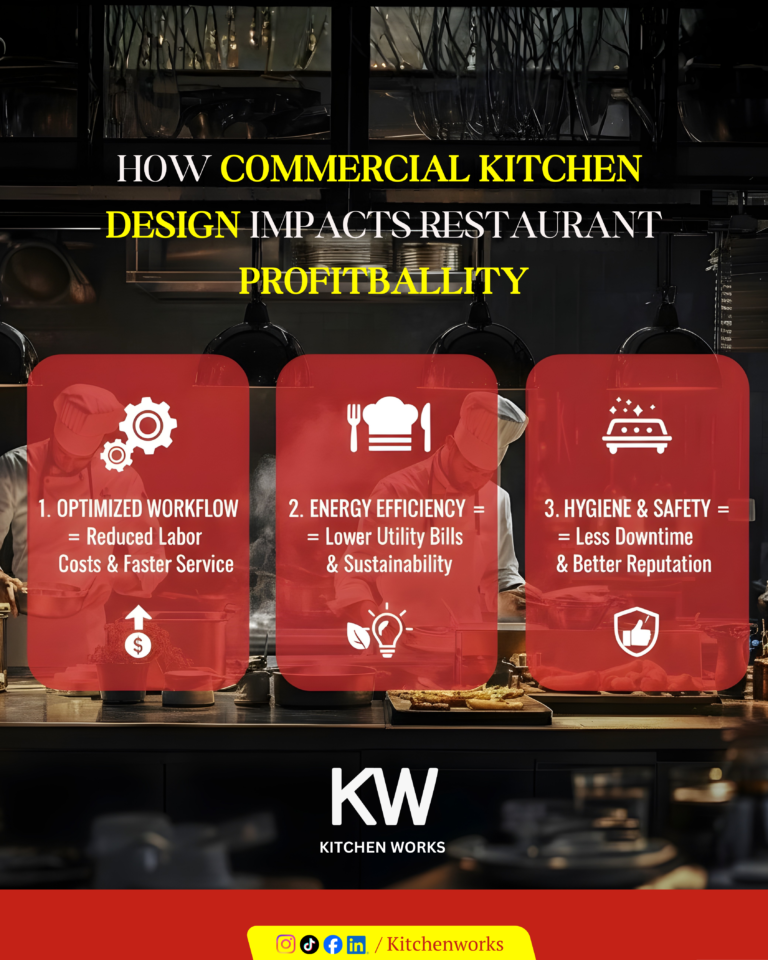
1. Optimized Workflow = Faster Service & Lower Labor Costs
An efficient kitchen layout minimizes unnecessary movement between stations. When chefs and staff can work seamlessly, you gain:
- Faster order turnaround
- Reduced staff fatigue
- Fewer operational errors
- Lower staffing requirements during peak hours
Popular commercial kitchen layouts in the UAE include:
- Assembly line layout (ideal for fast food & cloud kitchens)
- Island layout (fine dining & hotels)
- Zone-based layout (multi-cuisine restaurants)
Each layout impacts profitability differently based on your concept.
2. Energy-Efficient Design Lowers Utility Bills
Electricity and gas costs are major expenses for UAE restaurants due to long operating hours and heavy equipment usage.
A smart commercial kitchen design includes:
- Energy-efficient cooking equipment
- Proper ventilation & exhaust placement
- Heat zoning to reduce AC load
- LED lighting and smart controls
Over time, these design choices result in thousands of dirhams saved annually.
3. Space Optimization Maximizes Revenue Potential
In cities like Dubai, every square meter matters.
A professional restaurant kitchen layout ensures:
- Maximum equipment usage in minimal space
- Proper storage planning (dry, cold, frozen)
- Clear separation of prep, cooking, washing, and service areas
This allows you to allocate more space to revenue-generating dining areas without compromising kitchen efficiency.
Compliance-Driven Kitchen Design Avoids Costly Penalties
Non-compliance with UAE food safety regulations can lead to:
- Heavy fines
- Temporary shutdowns
- Loss of trade license
- Reputation damage
A compliant commercial kitchen design UAE must include:
- Proper food flow (receiving → storage → prep → cooking → service)
- Separate raw and cooked food zones
- Hand wash stations in required locations
- Grease traps and proper drainage
- HACCP-friendly surfaces and materials
Designing compliance from day one is far cheaper than fixing violations later.
Equipment Planning & Its Impact on ROI
Right Equipment = Lower Maintenance + Higher Output
Incorrect equipment selection leads to:
- Over-consumption of energy
- Frequent breakdowns
- Underutilized capacity
A professional kitchen designer:
- Matches equipment capacity to menu volume
- Selects UAE-approved brands
- Plans correct electrical and gas loads
- Ensures ergonomic placement
This directly improves equipment lifespan and ROI.
Staff Productivity & Retention Through Better Kitchen Design
High staff turnover is a hidden cost in the restaurant business.
A well-designed commercial kitchen:
- Reduces physical strain
- Improves communication between stations
- Enhances safety
- Creates a better working environment
Happy staff = better performance = better customer experience = higher profits.
How Kitchen Design Supports Menu Engineering & Scalability
Your kitchen design should support future growth, not limit it.
With the right planning:
- New menu items can be added easily
- Cloud kitchen or delivery operations can be integrated
- Volume can be increased without redesigning the kitchen
This scalability is crucial in the UAE’s dynamic F&B market.
Commercial Kitchen Design for Different Restaurant Types in the UAE
1. Fine Dining Restaurants
- Focus on workflow precision
- Island cooking stations
- Advanced ventilation systems
2. Fast Food & QSR
- Assembly-line layouts
- Speed-focused design
- Compact equipment planning
3. Cafés & Bakeries
- Front-of-house integration
- Efficient prep & baking zones
4. Cloud Kitchens
- High-density layouts
- Multiple brands under one roof
- Delivery-optimized workflow
Each concept requires a customized commercial kitchen design UAE approach.
Why Professional Commercial Kitchen Design Is a Smart Investment
DIY or contractor-only kitchen planning often leads to:
- Redesign costs
- Compliance issues
- Operational inefficiencies
Working with experienced professionals like Kitchen Works ensures:
- End-to-end kitchen planning
- Municipality-approved designs
- Equipment consultation
- Long-term cost efficiency
How Kitchen Works Helps Maximize Restaurant Profitability
At Kitchen Works, we specialize in commercial kitchen design in the UAE tailored to your business goals.
Our Expertise Includes:
- Custom kitchen layout planning
- Municipality-approved drawings
- Energy-efficient equipment selection
- Turnkey kitchen solutions
- Support for restaurants, hotels, cafés & cloud kitchens
We don’t just design kitchens—we design profitable foodservice operations.
Key Benefits of Choosing Kitchen Works
- Deep understanding of UAE regulations
- ROI-focused kitchen layouts
- Space-efficient designs
- Future-ready scalability
- Reliable after-design support
Final Thoughts: Design Smart, Profit More
In the UAE’s competitive restaurant industry, commercial kitchen design is a strategic business decision, not a technical formality.
A well-planned kitchen:
- Reduces costs
- Increases efficiency
- Enhances compliance
- Improves staff performance
- Boosts long-term profitability
If you’re planning a new restaurant or upgrading an existing one, investing in professional commercial kitchen design UAE services can be the difference between surviving and thriving.
Frequently Asked Questions (FAQ)
1. How much does commercial kitchen design cost in the UAE?
Costs vary based on size, concept, and equipment, but professional design saves significantly more in long-term operational expenses.
2. Is municipality approval required for kitchen design?
Yes. All commercial kitchens in the UAE must comply with local municipality regulations before operation.
3. Can kitchen design really impact restaurant profits?
Absolutely. Efficient design reduces labor, energy, and maintenance costs while improving output and service speed.
4. What is the best kitchen layout for UAE restaurants?
There is no one-size-fits-all. The best layout depends on your menu, service model, and available space.
5. Why choose Kitchen Works for commercial kitchen design?
Kitchen Works combines local regulatory expertise with profit-driven design strategies to deliver long-term value.